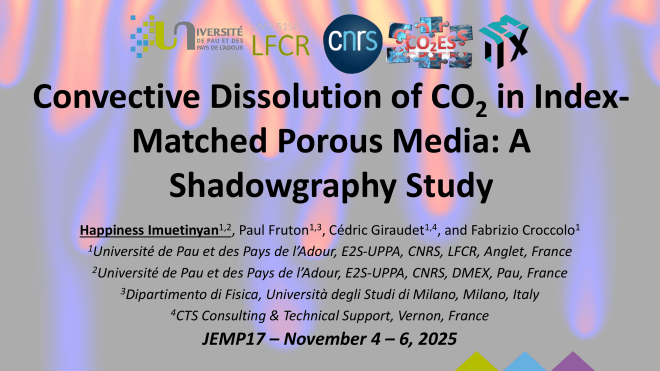
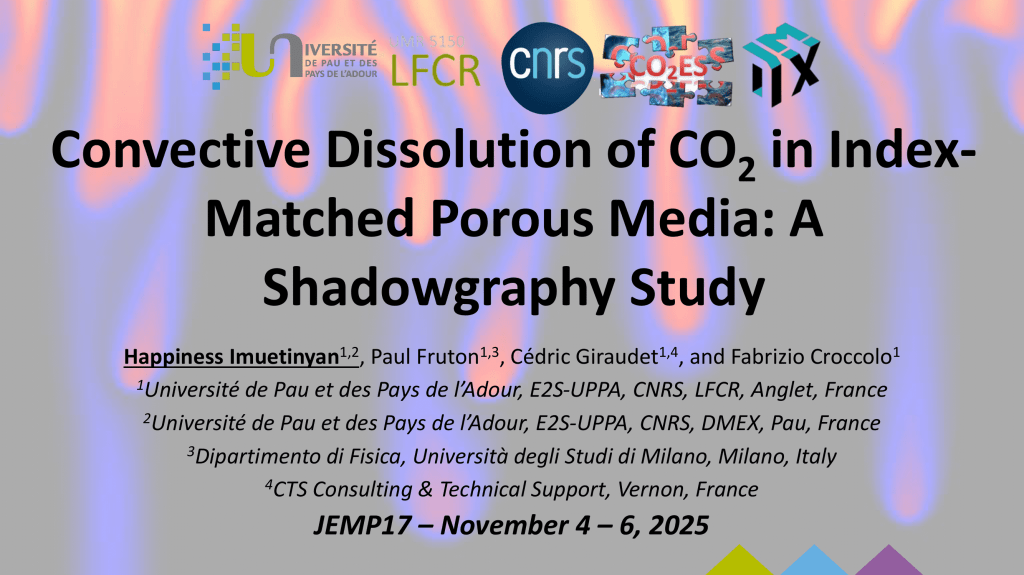
I am pleased to announce my participation in the 17ᵗʰ Journées d’Études des Milieux Poreux (JEMP 2025), organised by the France InterPore Chapter, which will be held in Orléans, France. This conference brings together scientists and industry experts who study the movement and transport within porous materials systems, which are vital to energy, environmental, and industrial applications.
During the conference, I will present my recent work on the convective dissolution of CO₂ in porous media, a process of great significance for geological carbon storage. Using dynamic shadowgraph imaging, my research investigates how CO₂ dissolves into a cyclohexanol/toluene (70/30 w/w) mixture and progresses through complex convective patterns within synthetic porous samples made of glass beads. These experiments illuminate the characteristic fingering structures that develop during dissolution and offer experimental data for testing theoretical scaling relationships between convective fluxes and Rayleigh numbers.
This research aims to strengthen the connection between experimental visualisation and predictive modelling, aiding in improving our understanding of how CO₂ behaves once injected underground. A clearer understanding of these processes is crucial for evaluating the long-term safety and efficiency of carbon storage in saline aquifers.
 Happiness Imuetinyan