A new study in Nature Communications shows that supercritical CO2 spontaneously stratifies in layers with sharply different properties when it’s pushed out of equilibrium by a stabilising temperature gradient.
Anglet, France — 11 August 2026
Supercritical fluids are commonly described as a phase that is neither gas nor liquid, with properties that vary continuously between the two. This in-between character makes supercritical fluids useful for industrial applications because they combine the high density of a liquid with the low viscosity of a gas. Supercritical CO2 transported through pipelines is a good example where its high density enables efficient transfer, while its low viscosity reduces energy consumption.
A new study led by researchers at the Université de Pau et des Pays de l’Adour (UPPA), just published in Nature Communications, shows that this picture only holds when the fluid is left undisturbed at equilibrium. When supercritical CO2 is subjected to non-equilibrium conditions, e.g. a stabilising temperature gradient, the kind found in real pipe, reservoir, or industrial process, it spontaneously organises itself into distinct layers, each with its own thermal and mechanical behaviour.
How They Did It
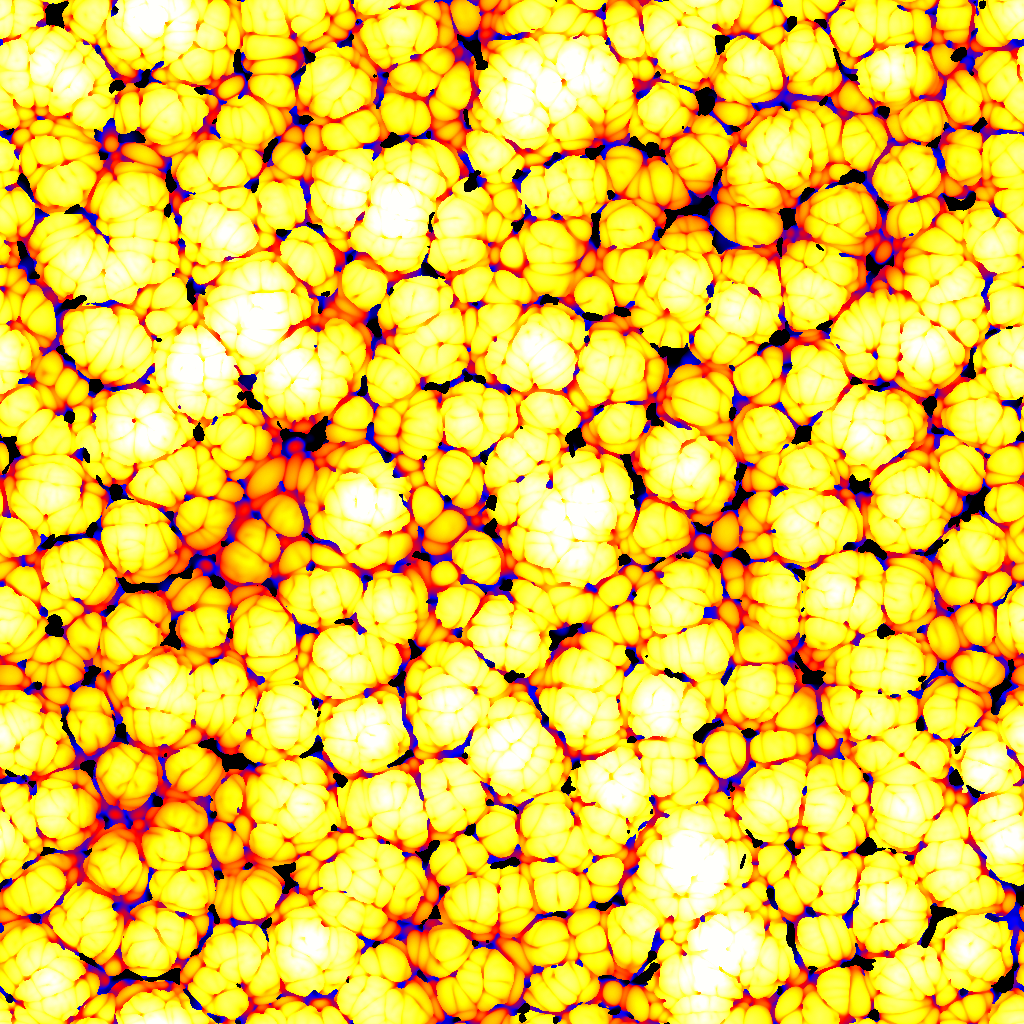
The team used a high-sensitivity optical technique called dynamic shadowgraphy to track mesoscopic-to-macroscopic, naturally occurring density fluctuations within a layer of supercritical CO2 held in a specialised high-pressure cell. By applying a controlled vertical temperature difference across the fluid, heating from above, and analysing how fluctuations at different spatial scales evolved and decayed over time, the researchers could effectively “watch at” the fluid’s internal dynamics without disturbing it.
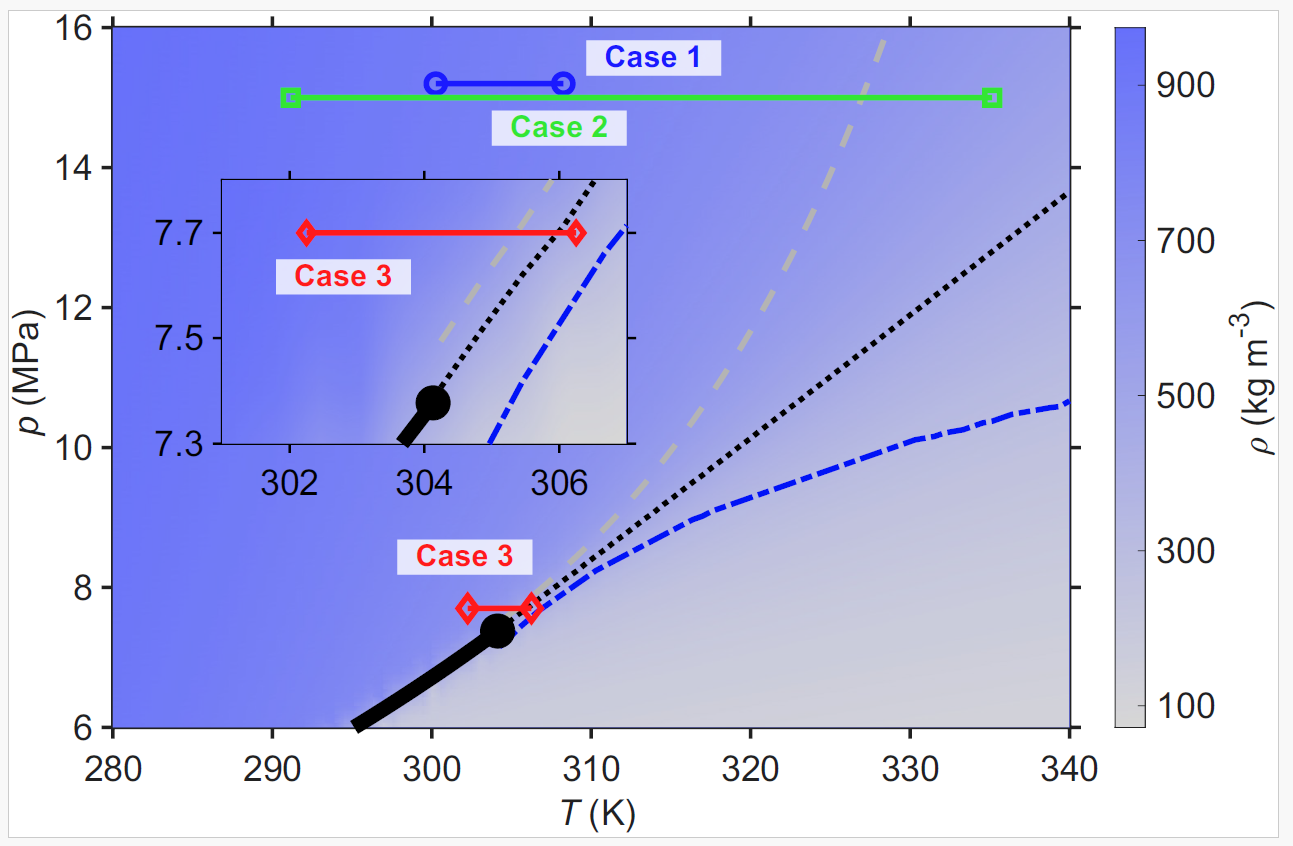
They ran three experiments at different pressures and temperature gradients, deliberately chosen to probe the fluid at increasing proximity to its critical point and to the so-called Widom lines, extended, ghostly traces of the liquid-gas boundary that persist into the supercritical region and mark where properties like density and heat capacity vary most sharply.
What They Found
- Far from the Widom region, the fluid behaved close to the classic textbook picture: its properties varied smoothly, and the fluctuation data were well described by a single, uniform layer with one characteristic Brunt-Väisälä oscillation frequency.
- Closer to the Widom region, that simple picture broke down. The data could only be explained by assuming the fluid was effectively split into two distinct sublayers, each behaving as if it had its own local thermal expansion coefficient.
- Right next to the critical point, the effect was strongest of all: the fluctuation signal required three distinct sublayers to accurately model the complete dynamics of the system, with thermal expansion coefficients differing by more than an order of magnitude between the “bottom” and “top” of the sample. The researchers describe this as a signature of a quasi-liquid and two transition layers.
Each of these layers showed its own distinct Brunt-Väisälä oscillation, the same physics that produces internal waves in stratified oceans and atmospheres, indicating that gravity was coupling the fluid’s thermal and viscous behaviour differently at different depths. This is, in effect, direct hydrodynamic evidence that a supercritical fluid under realistic conditions is not a single homogeneous phase but a stack of dynamically distinct layers.
A further benefit of the method: because a single experiment spans a continuous range of temperatures and pressures across the fluid layer, the team could effectively sample many points of the phase diagram and extract quantitative thermophysical properties (thermal diffusivity, viscosity, thermal expansion) at each depth without needing a new setup for every condition.
Why It Matters
Supercritical CO2 is central to various industrial and environmental technologies, including carbon capture, utilisation, and storage (CCUS), enhanced geothermal systems, processes in the pharmaceutical and food industries, and supercritical CO2 power cycles utilised in next-generation energy plants. Supercritical CO2 is seen as a medium with unique dynamics that break down out of equilibrium, especially near the critical point, where tiny thermal variations induce large gradients. This study suggests that under realistic, non-equilibrium conditions, that assumption can break down, and engineers may effectively be dealing with a layered medium rather than a single homogeneous one, with implications for how heat, mass, and momentum move through these systems.
The findings also open a new conceptual angle on the physics of the critical region itself. Existing theoretical frameworks describe the Widom region using equilibrium concepts. This study instead probes it dynamically, through non-equilibrium fluctuations, and finds structure that equilibrium pictures alone don’t capture. This stratified-hydrodynamics framework could extend to other systems shaped by non-equilibrium gradients, including planetary atmospheres and interiors, where such gradients are the norm rather than the exception.
The team notes an open question for future work: whether this stratification would persist under reduced-gravity conditions, which would help clarify how much of the effect is driven by temperature versus buoyancy itself.
The Team
The study was led by Paul Fruton, working with Emma Lisoir, Happiness Imuetinyan, Cédric Giraudet, and Fabrizio Croccolo. The core work was carried out at the LFCR laboratory (CNRS / E2S UPPA / Université de Pau et des Pays de l’Adour). The project was conceived by Cédric Giraudet and supervised by Paul Fruton and Fabrizio Croccolo, who also led its funding and management.
The research was carried out within the E2S UPPA Hub Newpores and the CO2ES Industrial Chair, with support from the French government’s Investissements d’Avenir program (ANR) and from CNES via CNRS GdR 2799 MFA.
“We went in expecting to measure the usual smooth fluctuations of a supercritical fluid. Instead, we found the fluid was quietly splitting itself into layers, each behaving like its own little pocket with different physical properties. That wasn’t something we set out to find.”
Read the Full Study
Non-Equilibrium Stratification in Supercritical CO2 Fruton, P., Lisoir, E., Imuetinyan, H., Giraudet, C. & Croccolo, F. Nature Communications (2026). DOI: 10.1038/s41467-026-74538-3
The article is published under a Creative Commons Attribution-NonCommercial-NoDerivatives (CC BY-NC-ND) license. Processed data underlying the figures are openly available via figshare (DOI: 10.6084/m9.figshare.32408229); raw imaging data are available from the corresponding author on request.
For media inquiries, please contact: fabrizio.croccolo@univ-pau.fr