Tag: CO2 storage

  • A New Chapter: From My Postdoctoral Research in France to the University of Udine

    A New Chapter: From My Postdoctoral Research in France to the University of Udine

    I am delighted to share an important milestone in my academic and professional journey. After completing my postdoctoral research position at the DMEX Centre for X-ray Imaging at the Université de Pau et des Pays de l’Adour (UPPA), I have begun a new chapter as a Postdoctoral Researcher at the Università degli Studi di Udine, Italy.

    This transition marks the beginning of an exciting new chapter in my research career and an opportunity to contribute to important scientific work on underground hydrogen storage, porous media, and advanced experimental characterisation techniques.

    An enriching chapter in France

    My time in Pau represented an important stage in the development of my research career. Working at the DMEX Centre for X-ray Imaging allowed me to further develop my experimental research expertise, particularly in applying X-ray computed tomography (X-ray CT) to investigate multiphase processes in porous media.

    My research focused on understanding processes relevant to carbon dioxide storage, with particular attention to the behaviour and dissolution of CO₂ in porous reservoir rocks. This work allowed me to combine experimental techniques, advanced imaging methods and quantitative image analysis to investigate fundamental processes relevant to geological carbon storage.

    Beyond the research itself, my time in France also offered significant professional growth. I had the privilege of collaborating with researchers, participating in scientific meetings and conferences, and contributing to discussions within the broader porous media, energy and carbon storage research communities.

    I am grateful to my colleagues, collaborators, and everyone at UPPA and the DMEX Centre who helped make this period both productive and memorable.

    Beginning a new chapter in Udine

    I am now pleased to begin the next stage of my academic journey at the Università degli Studi di Udine, Italy.

    My new position is connected to the FUSE–UD-H2 project (Open Infrastructure on Future Underground Hydrogen Storage), an exciting research initiative focused on scientific challenges related to the future of underground hydrogen storage. This new role offers an opportunity to build on my experience in porous media and experimental research while expanding into the growing field of hydrogen and subsurface energy storage.

    I look forward to working in a new research environment, developing new collaborations and contributing to research addressing important challenges in the energy transition.

    Looking ahead

    Moving from France to Italy represents another exciting step in my international academic journey.

    I will always value the experiences, knowledge and friendships gained during my time in France. As I begin this new chapter in Udine, I look forward to the opportunities, challenges, and discoveries ahead.

    Merci, la France, pour un chapitre inoubliable. 🇫🇷

    Ciao, Italia. Inizia un nuovo viaggio. 🇮🇹

  • A Week in Bergen: My Experience at the 8th International Workshop on Offshore Geologic CO₂ Storage

    A Week in Bergen: My Experience at the 8th International Workshop on Offshore Geologic CO₂ Storage

    Last April, I packed my bags and headed to Bergen, Norway, for the 8th International Workshop on Offshore Geologic CO₂ Storage, which is two days of cutting-edge science, lively debate, and one unforgettable site visit. Organised by IEAGHG and the Gulf Coast Carbon Centre (GCCC), hosted by Equinor, and bringing together researchers, engineers, regulators, and industry players from around the world, this workshop is unlike any other event in the CCS calendar. Here’s what I took away.

    First Impressions: Bergen Sets the Scene

    Bergen is the kind of city that makes you feel like science matters. Surrounded by mountains and fjords, with the UNESCO-listed Bryggen wharf right around the corner from the conference venue, there’s something quietly inspiring about doing climate work here in a country that has been pioneering offshore CO₂ storage since the 1990s. About 3,000 Equinor employees work in the Bergen region alone, and you can feel the energy of a place where decarbonisation isn’t just a talking point, but it’s the day job.

    Day 1: A World Tour of CO₂ Storage Projects

    The workshop kicked off with an extraordinary international project roundup. In under two hours, we heard updates from CO₂ storage initiatives across the Americas, Europe, and Asia-Pacific, such as from Brazil (Petrobras), the Netherlands (Porthos), Denmark (Greensands and Bifrost), Greece (Prinos), Portugal, South Korea, Japan (Tomakomai), Taiwan, and multiple Australian projects, including CarbonNet and DeepC Store. It was a vivid reminder of just how global this effort has become.

    What struck me most was the sheer diversity of geological settings, regulatory frameworks, and project maturity levels represented in that single room. Some projects are still in exploration; others are already injecting. The gap between those stages and what it takes to bridge it ran as a thread through many of the discussions that followed.

    The afternoon moved into basin-scale management, one of the more technically complex yet critically important topics in offshore CCS. How do you manage pressure across a shared geological basin when multiple projects are injecting CO₂ into the same formations? Talks from NORCE and Norway’s regulator, SODIR, gave a sobering yet fascinating look at the regulatory and modelling challenges this poses. The session on prospect development rounded out the day, with presentations on legacy well screening, brine management, and aquifer modelling, the nuts and bolts of making a CO₂ storage site work safely over decades.

    Presenting My Research: Convective CO₂ Dissolution Under the X-ray Spotlight

    I had the privilege of presenting a poster on our group’s work at the DMEX Centre for X-ray Imaging at the Université de Pau et des Pays de l’Adour. Our research tackles a question that lies at the heart of long-term CO₂ storage safety: once CO₂ is injected underground and begins dissolving into the resident brine, how does it actually move through the rock?

    This process, called convective dissolution, is one of the key mechanisms by which CO₂ becomes permanently trapped underground. As CO₂-rich brine is denser than fresh brine, it sinks and drives a circulation that accelerates dissolution. The problem is that this process is extremely difficult to observe directly, especially in 3D, under realistic reservoir conditions.

    That’s exactly what we set out to do. Using our purpose-built X-ray tomography setup, we can image convective plumes forming and propagating through actual porous rock cores in real time, at pressures of 40–50 bar. The conversations my poster sparked were genuinely exciting as other researchers were curious about the experimental setup, the image analysis approach, and how our findings might inform reservoir simulations.

    Day 2: From Injection Lessons to Monitoring Innovation

    Day 2 had a different energy; it was more operational and focused on the current situation on the ground. The injection session opened with lessons learned from four live projects: Northern Lights, Greensands (Denmark), Poseidon (UK), and the Ravenna project in Italy. Each project is at an early stage of injection, and each came with candid reflections on what surprised them, what worked, and what they’re still figuring out.

    The monitoring sessions were, for me, one of the highlights of the whole workshop. CCS only works if we can verify that the stored CO₂ stays where we put it, and the scientific creativity behind monitoring right now is remarkable. Talks covered seismic integration, full-waveform inversion at the legendary Sleipner site, fibre-optic sensing (an enLightening story, as the presenter cheekily called it), passive acoustics, and citizen-science approaches. Each session opened up new questions: How do you monitor in a crowded offshore environment where other infrastructure gets in the way? How do you scale monitoring programs as injection ramps up?

    The afternoon’s interactive panel on the evolution of monitoring programs from baseline surveys through to full injection brought operators and regulators together in a way that felt genuinely collaborative. Hearing a Norwegian regulator (SODIR) and the UK’s NSTA discuss their approaches side by side was a valuable window into how governance frameworks are converging and where they’re still diverging.

    The Northern Lights Site Visit: Seeing CCS in Action

    If the two workshop days were the mind, the site visit to the Northern Lights project was the heart.

    We departed Bergen at 8am and arrived at the facility, where we were welcomed by the operations team. Northern Lights is the world’s first commercial cross-border CO₂ transport and storage service receiving CO₂ captured from industrial sources across Northern Europe, shipping it by tanker to Norway, and injecting it into a geological formation 2,600 metres beneath the North Sea seabed. The group from a previous workshop had visited the site back in 2020, before construction began. Seeing it now operational, with ships docking and CO₂ flowing, was extraordinary.

    We heard from the operations manager about the journey from concept to reality, the logistics of managing a fleet of ships, and what the early injection period has taught the team. The mayor of Øygarden municipality also spoke about what it means for a coastal community to have this new industry take root, a reminder that the social and economic dimensions of CCS are as real as the geological ones.

    The site itself is striking: a compact, purpose-built facility perched on the Norwegian coastline, with the North Sea stretching out beyond it. Standing there, it’s hard not to feel the weight of what’s been achieved and the scale of what still needs to happen for CCS to make a meaningful dent in global emissions.

    Final Thoughts

    What I carry away from Bergen is something beyond the specific technical content, though there was plenty of that. It is a renewed sense that the offshore CCS community is moving from proof of concept to operational reality, and doing so with rigour, transparency, and an appetite for honest conversation about what’s hard.

    For a researcher working on the fundamental science of CO₂ storage, trying to understand what happens at the pore scale when CO₂ meets brine meets rock, workshops like this are invaluable. They connect the microscopic to the global, the laboratory to the seabed, the equation to the tank. And they remind you that the work is urgent, the stakes are real, and the community doing it is genuinely excellent.

    Until the 9th edition, wherever it may be held.

    The research presented in my poster was carried out with support from the EU (grant agreement No. 850853), the E2S UPPA Hub Newpores, the CO2ES industrial chair, the EquipEX IMAGINE², and the ISIFoR project BESCO.

  • Busting the Myths Around CO₂ Storage: Highlights from the SPE Distinguished Lecture, 4 June 2026

    Busting the Myths Around CO₂ Storage: Highlights from the SPE Distinguished Lecture, 4 June 2026

    This month, SPE France had the pleasure of hosting Diego A. Vazquez Anzola as part of the Society of Petroleum Engineers’ prestigious Distinguished Lecturer Programme. Diego’s talk titled“CO₂ Storage Risks and Costs: Busting Perceptions and Myths” was one of the most thought-provoking sessions I have attended in recent memory. With two decades of experience spanning hydrocarbon exploration, CCS project development and sustainable energy, Diego brought rare clarity to a topic that is often clouded by misconception and misplaced pessimism.

    His core argument was simple but powerful: Carbon Capture and Storage is necessary and technically achievable, but it will only become sustainable if it is investable. The IEA estimates we need to scale from 40 Mt of CO₂ stored today to around 5,000 Mt per year. That gap demands we get serious not just about engineering but also about business models, regulations, and operational realities.

    The lecture was structured around five myths that Diego systematically unpacked.

    Myth #1 – Long-term Carbon Storage Creates No Real Value

    The first misconception Diego tackled is perhaps the most damaging: the idea that CCS is purely a cost centre with no genuine value proposition. He walked us through a spectrum of emerging business models from regulatory “stick” mechanisms (carbon taxes, ETS pricing) to “carrot” incentives (the US 45Q tax credit, Australian Carbon Credit Units) and fully market-driven approaches such as storage-as-a-service or CO₂ utilisation into clean fuels like methanol, e-methane and sustainable aviation fuel.

    Real-world projects already demonstrate this: Sleipner in Norway has been operating since 1996; Moomba in Australia came online in 2024; and the Tangguh CCUS project in Indonesia reached FID in 2024. Each of these links CO₂ storage directly to a revenue stream, whether through enhanced gas recovery, carbon credit sales or avoided carbon taxes. The lesson is that CCS works best when it is designed around value generation from the outset, not bolted on as an afterthought.

    Myth #2 – Regulations Alone Enable CCS Projects

    A widely held belief is that a strong regulatory framework is sufficient to unlock CCS investment. Diego challenged this directly. Regulation is a necessary condition, not a sufficient one. Drawing on frameworks from the EU Directive 2009/31/EC, the US EPA Class VI rules, Australia’s OPGGS Act and the UK Energy Act 2008, he showed that while these provide the structural backbone, they are deliberately non-prescriptive, focused on risk management rather than dictating technical solutions.

    What matters, Diego argued, is the ability to translate regulatory requirements into practical, proportionate work plans. The regulation sets the boundary; the technical and commercial teams must do the rest.

    Myth #3 – Suitable Storage Sites Are Everywhere

    This was one of the talk’s most sobering moments. When comparing depleted hydrocarbon fields and saline aquifers as storage options, the trade-offs are significant. Depleted fields offer proven containment and better-understood geology, but come with legacy well complications and limited scale. Saline aquifers have enormous theoretical capacity, but injectivity, connectivity, and monitorability are often poorly characterised, requiring exploratory and appraisal wells before injection can begin.

    The implication is clear: finding a genuinely suitable storage site, one that ticks the boxes on containment, injectivity, monitorability and scalability, is harder and more expensive than commonly assumed. Site selection is not a desktop exercise.

    Myth #4 – CO₂ Injection is Simply the Reverse of Hydrocarbon Production

    This myth underestimates how thermodynamically unusual CO₂ behaves. Diego gave a compelling explanation of the Joule-Thomson effect: when CO₂ is forced through a pressure drop (as at a wellhead), it can cool to extreme temperatures, in real field cases as low as -45°C to -85°C. This creates serious material integrity challenges that simply do not arise in conventional production operations. Equipment qualification for these conditions is non-trivial, and ignoring it has real cost and safety consequences.

    It was a reminder that CO₂ injection is its own engineering discipline, not a mirror image of production.

    Myth #5 – Legacy Wells Are Easily Repurposed

    The final myth is one I suspect many in the audience had not fully considered. The presence of legacy abandoned wells in or near a storage reservoir is one of the most significant risk factors for CO₂ containment. Old cement can become brittle when exposed to CO₂; leakage pathways can develop along casing strings, through cement fractures or between cement and rock. Diego cited research showing corrosion rates on the order of 2–4 mm per year are manageable in isolation, but the brittleness induced by CO₂ exposure is the deeper concern.

    Repurposing a legacy well for CO₂ injection is not a shortcut, but it requires rigorous integrity evaluation and, in many cases, significant remedial work.

    Key Takeaway: Value, Maturation Time and Scalability

    Diego closed with a framework that I found genuinely useful. He proposed that the best measure of a CCS project’s success is not simply whether it stores CO₂ safely, but whether it performs well across three dimensions: value generation, maturation time, and scalability. CCS hubs, which are clusters of emitters sharing transport and storage infrastructure, score well on all three and are increasingly the model that front-runner projects are converging on.

    Government incentives help, Diego noted, but they are not the primary driver of the best projects. The projects that work are those built around a coherent value proposition from day one.

    It was an exceptional evening of knowledge-sharing. My thanks to Diego for a genuinely memorable session and to everyone who joined us.

    For more information on the SPE Distinguished Lecturer Programme, visit www.spe.org/dl.

  • CO2 Sequestration: Linking Subsurface Physics to Practical Decarbonization

    CO2 Sequestration: Linking Subsurface Physics to Practical Decarbonization

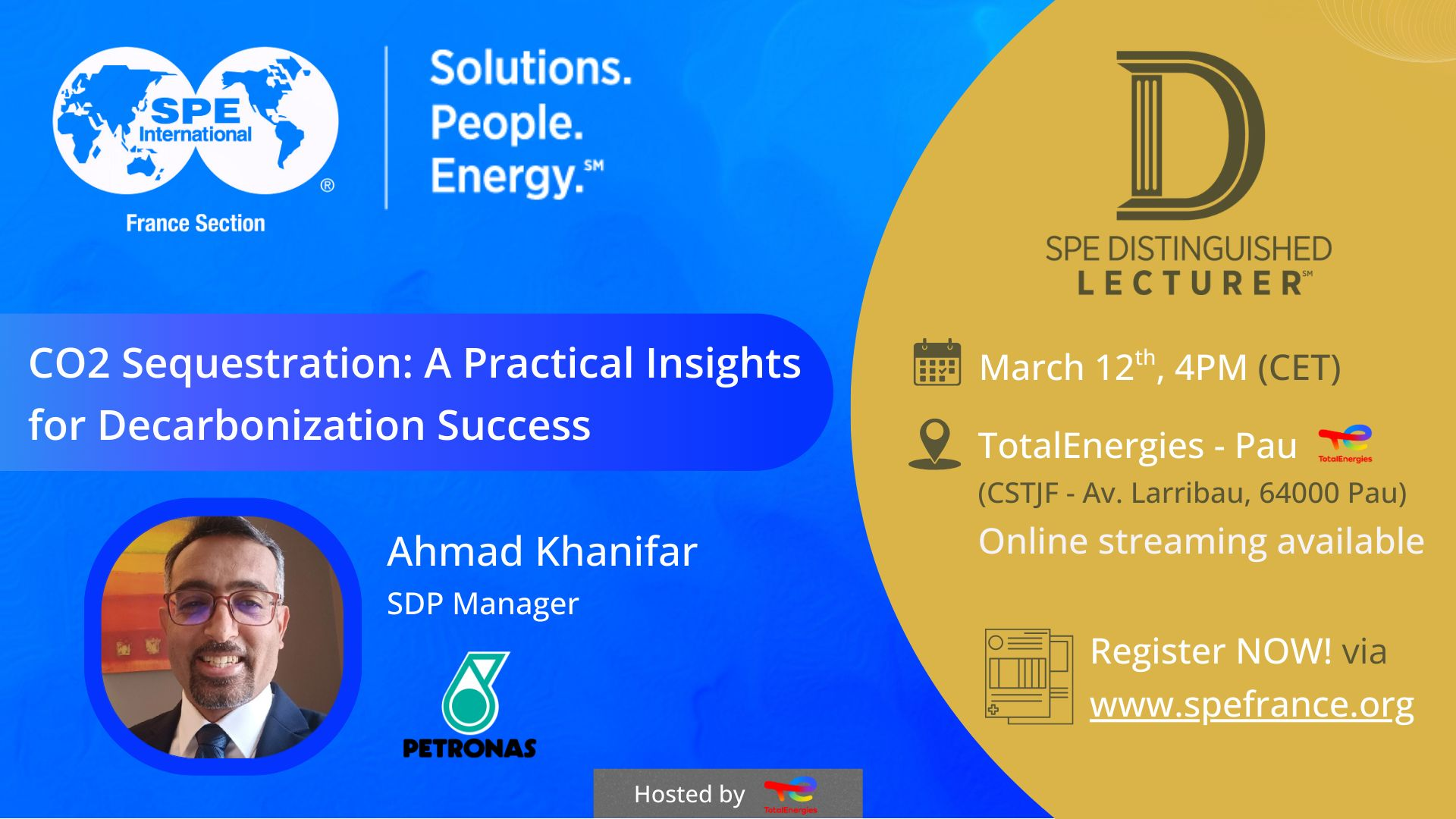
    Geological CO2 sequestration is emerging as a critical solution for reducing industrial emissions and enabling large-scale decarbonization. On March 12, 2026, the Society of Petroleum Engineers France Section will host a distinguished lecture titled “CO2 Sequestration: Practical Insights for Decarbonization Success,” bringing together researchers and industry professionals working at the forefront of carbon storage.

    Following injection into deep saline aquifers, CO2 becomes progressively trapped through mechanisms such as dissolution trapping, in which CO2 dissolves into brine, triggering density-driven convection. This process enhances long-term storage security by transporting dissolved CO2 deeper into the formation. Recent advances, including X-ray CT imaging of reservoir rocks, now allow researchers to directly observe and quantify these processes, improving predictive models and storage strategies.

    This lecture offers a valuable opportunity to gain practical insight into subsurface CO2 behaviour, learn from field and laboratory experience, and connect with the CCS community. It will be particularly relevant for researchers, engineers, and students interested in subsurface energy systems and climate solutions.

    If you are interested in carbon storage, subsurface engineering, or decarbonization technologies, I strongly encourage you to attend and engage in the discussion.

  • New Publication: Uncovering the Dynamics of CO₂ Convective Mixing in Porous Media

    New Publication: Uncovering the Dynamics of CO₂ Convective Mixing in Porous Media

    I am pleased to announce the publication of our latest research article in Transport in Porous Media, titled “Direct Observation of Convective Mixing During CO₂ Dissolution in Saturated Transparent Porous Media.”

    This study offers real-time visual evidence of how CO₂ dissolves and starts to mix convectively in porous media, a vital process for long-term geological carbon storage. While convective dissolution has been extensively modelled, direct observations under reservoir-like conditions are still scarce. Our research helps fill this gap.

    Using high-pressure optical shadowgraphy, we observed CO₂ dissolving into a saturated porous medium under controlled temperature and pressure conditions that simulate subsurface storage environments. This setup enabled us to capture:

    • The onset of convection,
    • The growth and acceleration of descending plumes,
    • And the quantitative scaling of plume velocity with the Rayleigh number.

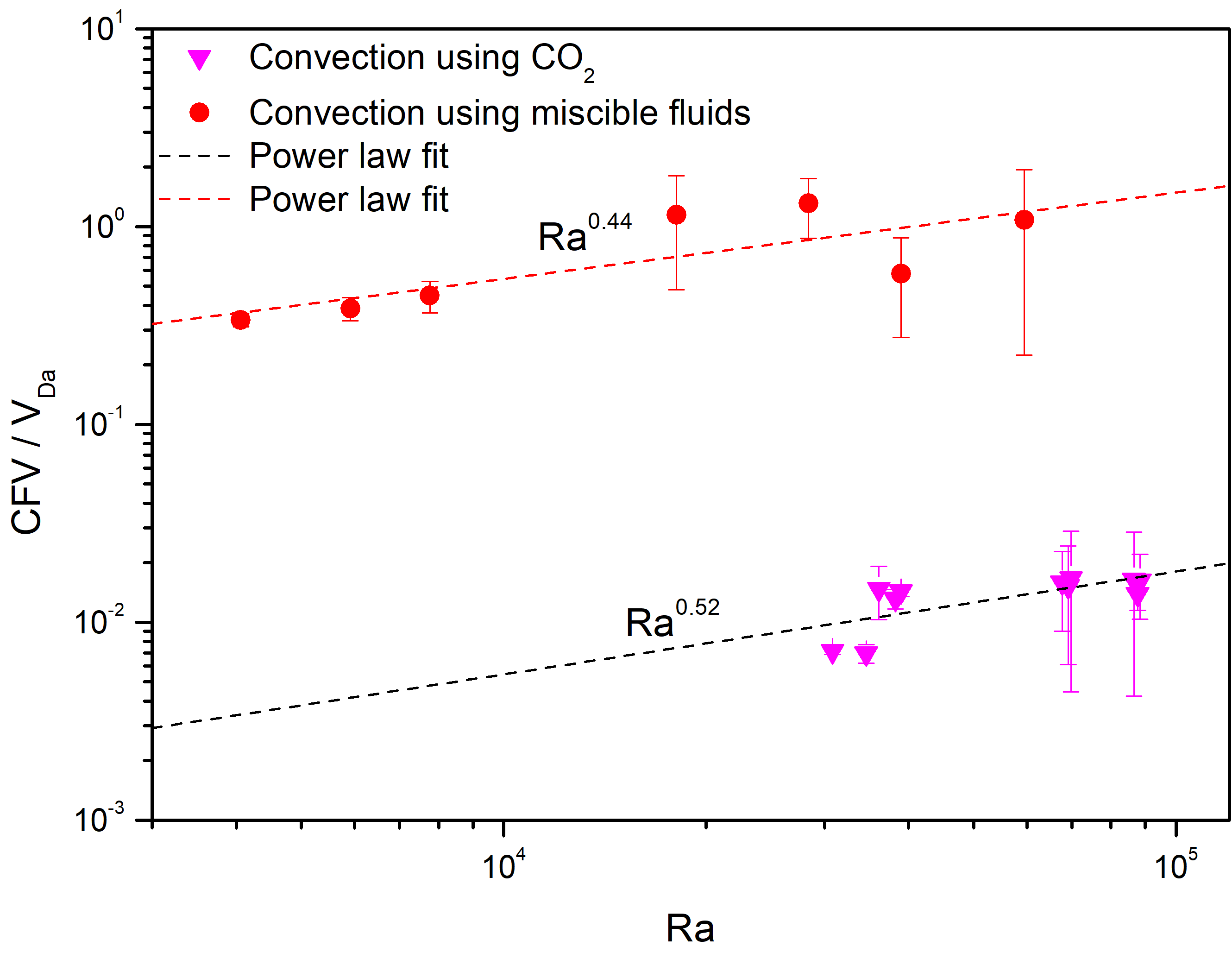
    Our results indicate that, within the studied conditions, the plume velocity approximately follows a square-root relationship with the Rayleigh number, providing new experimental support for predictions long established in theory and simulation. These measurements offer a valuable benchmark for refining models of CO₂ dissolution and improving forecasts of long-term storage efficiency.

    This work was made possible through collaboration with Fabrizio Croccolo, Paul Fruton, and Cedric Giraudet, whose contributions were essential to the project’s success.

    The article is available open access here:
    https://link.springer.com/article/10.1007/s11242-025-02259-0

  • Presenting at the 17th Journées d’Études des Milieux Poreux (JEMP 2025) – France InterPore Chapter, Orléans

    Presenting at the 17th Journées d’Études des Milieux Poreux (JEMP 2025) – France InterPore Chapter, Orléans

    I am pleased to announce my participation in the 17ᵗʰ Journées d’Études des Milieux Poreux (JEMP 2025), organised by the France InterPore Chapter, which will be held in Orléans, France. This conference brings together scientists and industry experts who study the movement and transport within porous materials systems, which are vital to energy, environmental, and industrial applications.

    During the conference, I will present my recent work on the convective dissolution of CO₂ in porous media, a process of great significance for geological carbon storage. Using dynamic shadowgraph imaging, my research investigates how CO₂ dissolves into a cyclohexanol/toluene (70/30 w/w) mixture and progresses through complex convective patterns within synthetic porous samples made of glass beads. These experiments illuminate the characteristic fingering structures that develop during dissolution and offer experimental data for testing theoretical scaling relationships between convective fluxes and Rayleigh numbers.

    This research aims to strengthen the connection between experimental visualisation and predictive modelling, aiding in improving our understanding of how CO₂ behaves once injected underground. A clearer understanding of these processes is crucial for evaluating the long-term safety and efficiency of carbon storage in saline aquifers.