Tag: Porous media

  • Story Behind the Paper: Free-interface convective mixing in porous media

    Story Behind the Paper: Free-interface convective mixing in porous media

    During my PhD, I held a 3-month PhD fellowship in the Department of Physics at the University of Torino, where I worked with Prof. Guido Boffetta and the Complex Systems group on the numerical simulation of convective mixing in porous media, a collaboration that became the core of this paper. Visiting Torino allowed me to immerse myself in advanced computational fluid dynamics and to better understand how fundamental fluid-mechanical instabilities manifest in porous structures, a topic at the crossroads of physics, engineering, and environmental science.

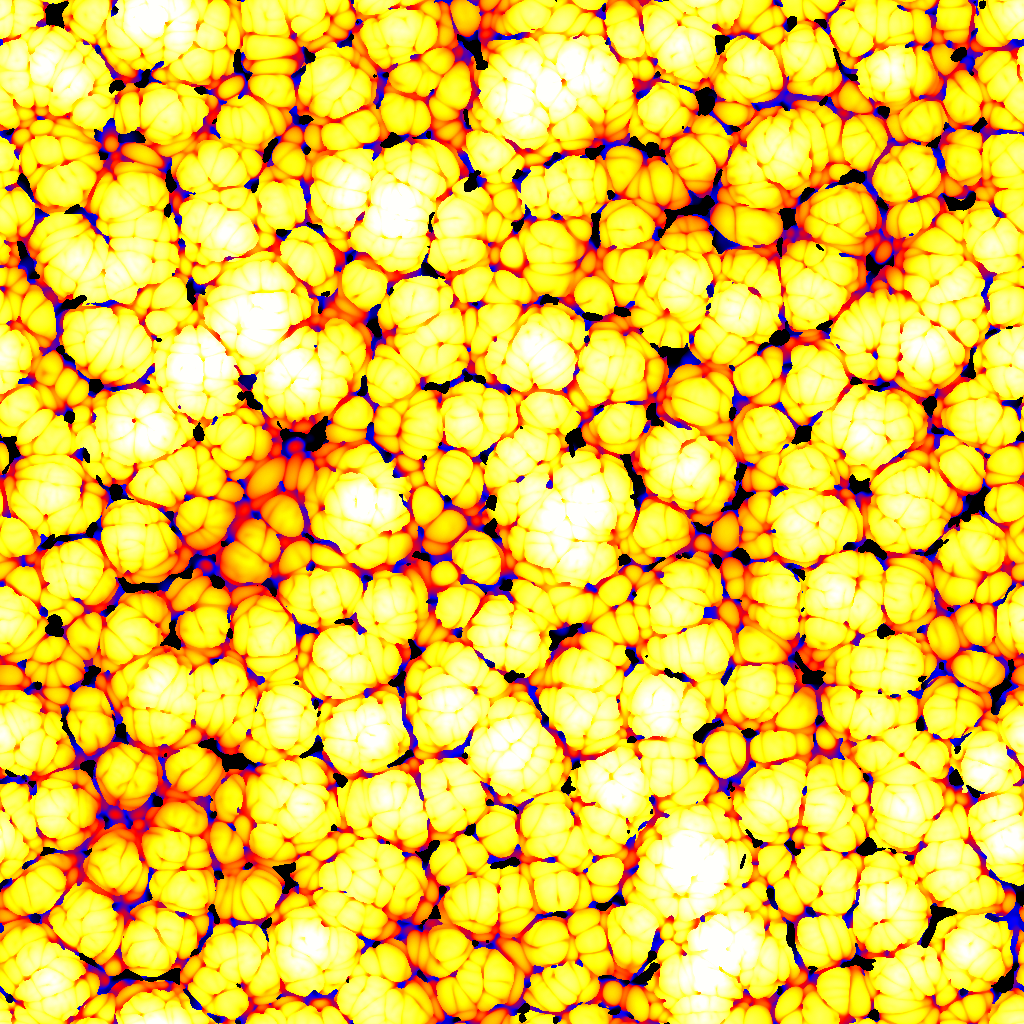
    The work examines a fluid-dynamic process that is simple in setup yet rich in physics: convective mixing driven by buoyancy in a porous medium with a free interface separating two miscible fluids. This configuration is a canonical model for situations in which a lighter fluid overlies a heavier one, and diffusive transport across the interface gradually alters the density field until an instability develops and vigorous mixing sets in. Such flows are fundamental to many natural and engineered systems, from groundwater contaminant transport and heat transfer in thermal insulation to geological carbon dioxide (CO2) sequestration, where dense CO2-rich brine can sink into deeper aquifers.

    In this study, we use high-resolution direct numerical simulations of the governing Darcy-scale flow equations to capture the initiation and evolution of convection when miscible fluids interact across a free interface in a porous medium. Our simulations were performed in both two-dimensional (2D) and three-dimensional (3D) geometries to quantify how spatial dimensionality affects plume development, mixing dynamics, and dissolution fluxes.

    A key finding is that, although both 2D and 3D simulations display similar qualitative convective behaviours, such as the formation of rising and sinking plumes that promote mixing, their mixing rates and structures differ. Specifically, the 2D setup tends to produce stronger convective fluxes and more rapid interface deformation compared to the 3D case, with dissolution fluxes approximately 15% higher. This highlights the need for caution when applying 2D results to real 3D systems, as dimensional effects can significantly influence outcomes. (Springer)

    What made this project particularly rewarding was the opportunity to collaborate across disciplines, blending physical intuition from fluid dynamics with computational techniques and environmental motivation. The fellowship in Torino was not just a change of scenery but a chance to grow as a researcher: to ask deeper questions about why mixing occurs the way it does and how seemingly small modelling choices (such as geometry or dimensionality) can have large consequences for interpretation. The result is more than a paper; it is a window into the multiscale complexity of convective processes that shape many phenomena in science and engineering.

    The free full-text PDF can be found at https://rdcu.be/e6m1G
  • New Publication: Uncovering the Dynamics of CO₂ Convective Mixing in Porous Media

    New Publication: Uncovering the Dynamics of CO₂ Convective Mixing in Porous Media

    I am pleased to announce the publication of our latest research article in Transport in Porous Media, titled “Direct Observation of Convective Mixing During CO₂ Dissolution in Saturated Transparent Porous Media.”

    This study offers real-time visual evidence of how CO₂ dissolves and starts to mix convectively in porous media, a vital process for long-term geological carbon storage. While convective dissolution has been extensively modelled, direct observations under reservoir-like conditions are still scarce. Our research helps fill this gap.

    Using high-pressure optical shadowgraphy, we observed CO₂ dissolving into a saturated porous medium under controlled temperature and pressure conditions that simulate subsurface storage environments. This setup enabled us to capture:

    • The onset of convection,
    • The growth and acceleration of descending plumes,
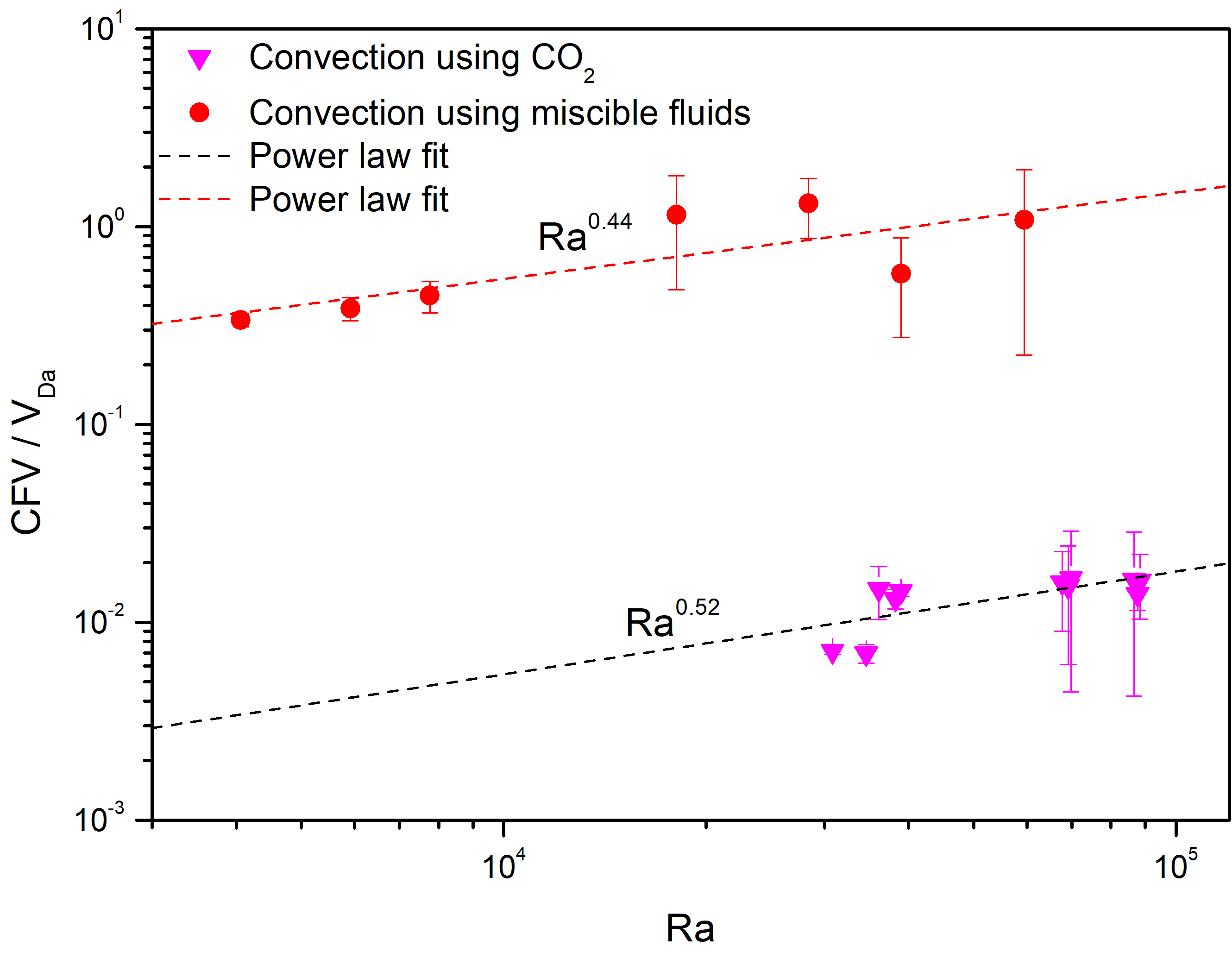
    • And the quantitative scaling of plume velocity with the Rayleigh number.

    Our results indicate that, within the studied conditions, the plume velocity approximately follows a square-root relationship with the Rayleigh number, providing new experimental support for predictions long established in theory and simulation. These measurements offer a valuable benchmark for refining models of CO₂ dissolution and improving forecasts of long-term storage efficiency.

    This work was made possible through collaboration with Fabrizio Croccolo, Paul Fruton, and Cedric Giraudet, whose contributions were essential to the project’s success.

    The article is available open access here:
    https://link.springer.com/article/10.1007/s11242-025-02259-0

  • Presenting at the 17th Journées d’Études des Milieux Poreux (JEMP 2025) – France InterPore Chapter, Orléans

    Presenting at the 17th Journées d’Études des Milieux Poreux (JEMP 2025) – France InterPore Chapter, Orléans

    I am pleased to announce my participation in the 17ᵗʰ Journées d’Études des Milieux Poreux (JEMP 2025), organised by the France InterPore Chapter, which will be held in Orléans, France. This conference brings together scientists and industry experts who study the movement and transport within porous materials systems, which are vital to energy, environmental, and industrial applications.

    During the conference, I will present my recent work on the convective dissolution of CO₂ in porous media, a process of great significance for geological carbon storage. Using dynamic shadowgraph imaging, my research investigates how CO₂ dissolves into a cyclohexanol/toluene (70/30 w/w) mixture and progresses through complex convective patterns within synthetic porous samples made of glass beads. These experiments illuminate the characteristic fingering structures that develop during dissolution and offer experimental data for testing theoretical scaling relationships between convective fluxes and Rayleigh numbers.

    This research aims to strengthen the connection between experimental visualisation and predictive modelling, aiding in improving our understanding of how CO₂ behaves once injected underground. A clearer understanding of these processes is crucial for evaluating the long-term safety and efficiency of carbon storage in saline aquifers.