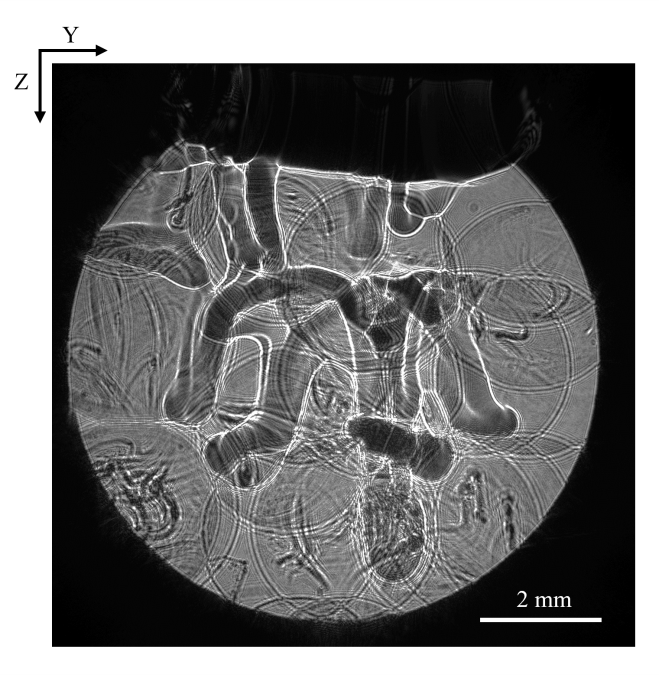
I am excited to share some insights into our recent research focused on visualising fluid flow within porous media. This work is important for understanding a range of natural and industrial processes, from groundwater pollution to underground CO2 storage.
The Challenge: Seeing the Unseen
One of the biggest hurdles in studying flow in porous media using visible light is that it is usually impossible to see what is happening within the medium. Traditional optical techniques just don’t work because the medium itself is opaque.
Our Solution: Making the Invisible Visible
To tackle this, we developed a novel experimental approach using shadowgraphy. The key was to create a transparent porous medium by carefully matching the refractive index of the solid and liquid phases. This allowed us to directly observe convective plumes as they spread.
What We Discovered
Our experiments revealed a clear relationship between the density difference of the fluids and the velocity of the convective plumes. This is a significant finding because it provides a way to predict the intensity of convective mixing by measuring the speed at which the plumes move.
Why This Matters
This research has the potential to advance our understanding in several areas, including:
- Environmental science: Improving strategies for groundwater remediation.
- Energy industry: Optimising techniques for underground storage of CO2.
What’s Next?
Our future work will delve deeper into the convective mixing of CO2 in porous media under process-relevant pressure and temperature conditions.
Want to Learn More?
For those interested in the technical details, the full paper is available here.
 Happiness Imuetinyan