Category: new publication

Blog post and press release about my newly published articles

  • New Publication: Uncovering the Dynamics of CO₂ Convective Mixing in Porous Media

    New Publication: Uncovering the Dynamics of CO₂ Convective Mixing in Porous Media

    I am pleased to announce the publication of our latest research article in Transport in Porous Media, titled “Direct Observation of Convective Mixing During CO₂ Dissolution in Saturated Transparent Porous Media.”

    This study offers real-time visual evidence of how CO₂ dissolves and starts to mix convectively in porous media, a vital process for long-term geological carbon storage. While convective dissolution has been extensively modelled, direct observations under reservoir-like conditions are still scarce. Our research helps fill this gap.

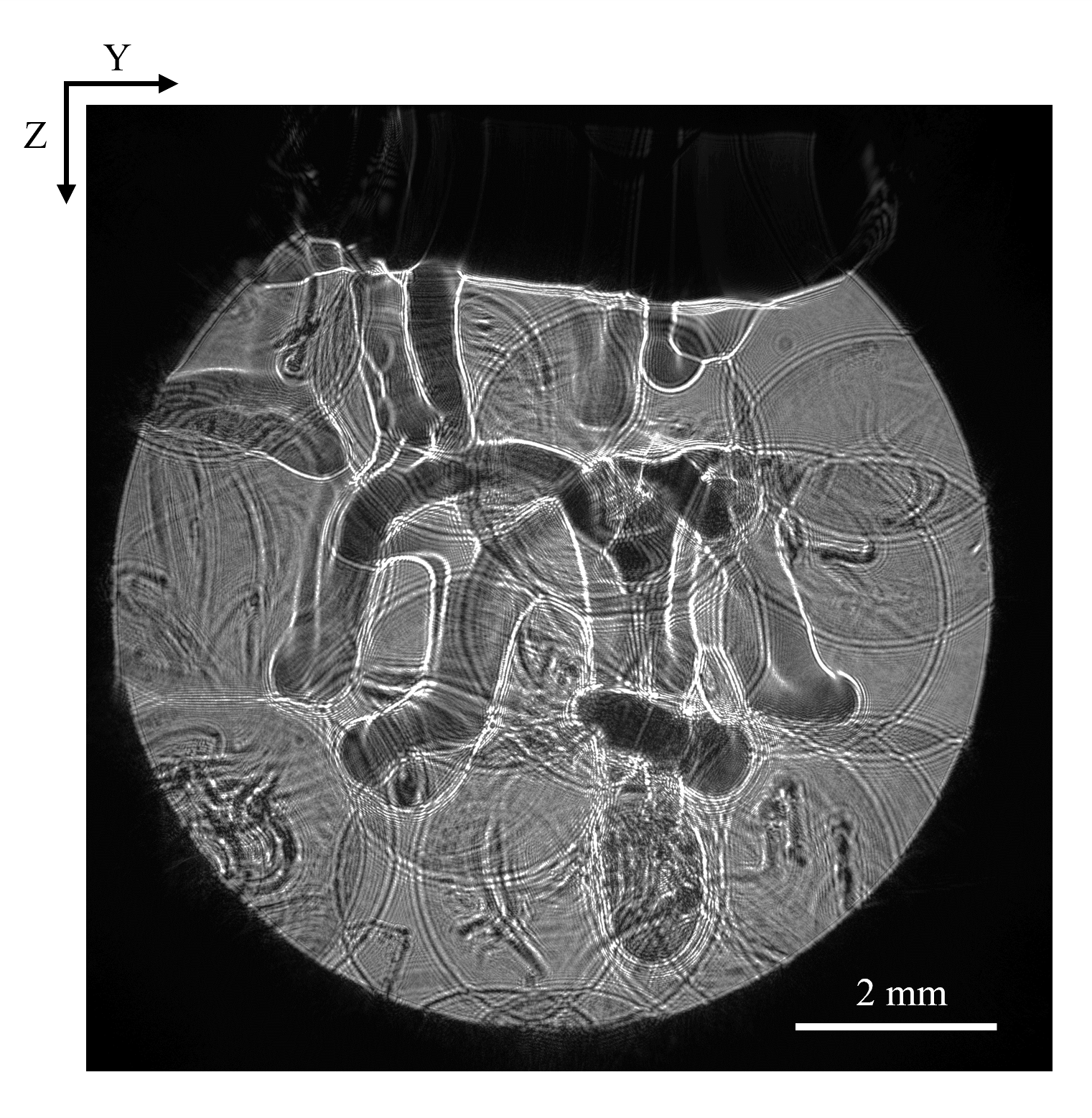
    Using high-pressure optical shadowgraphy, we observed CO₂ dissolving into a saturated porous medium under controlled temperature and pressure conditions that simulate subsurface storage environments. This setup enabled us to capture:

    • The onset of convection,
    • The growth and acceleration of descending plumes,
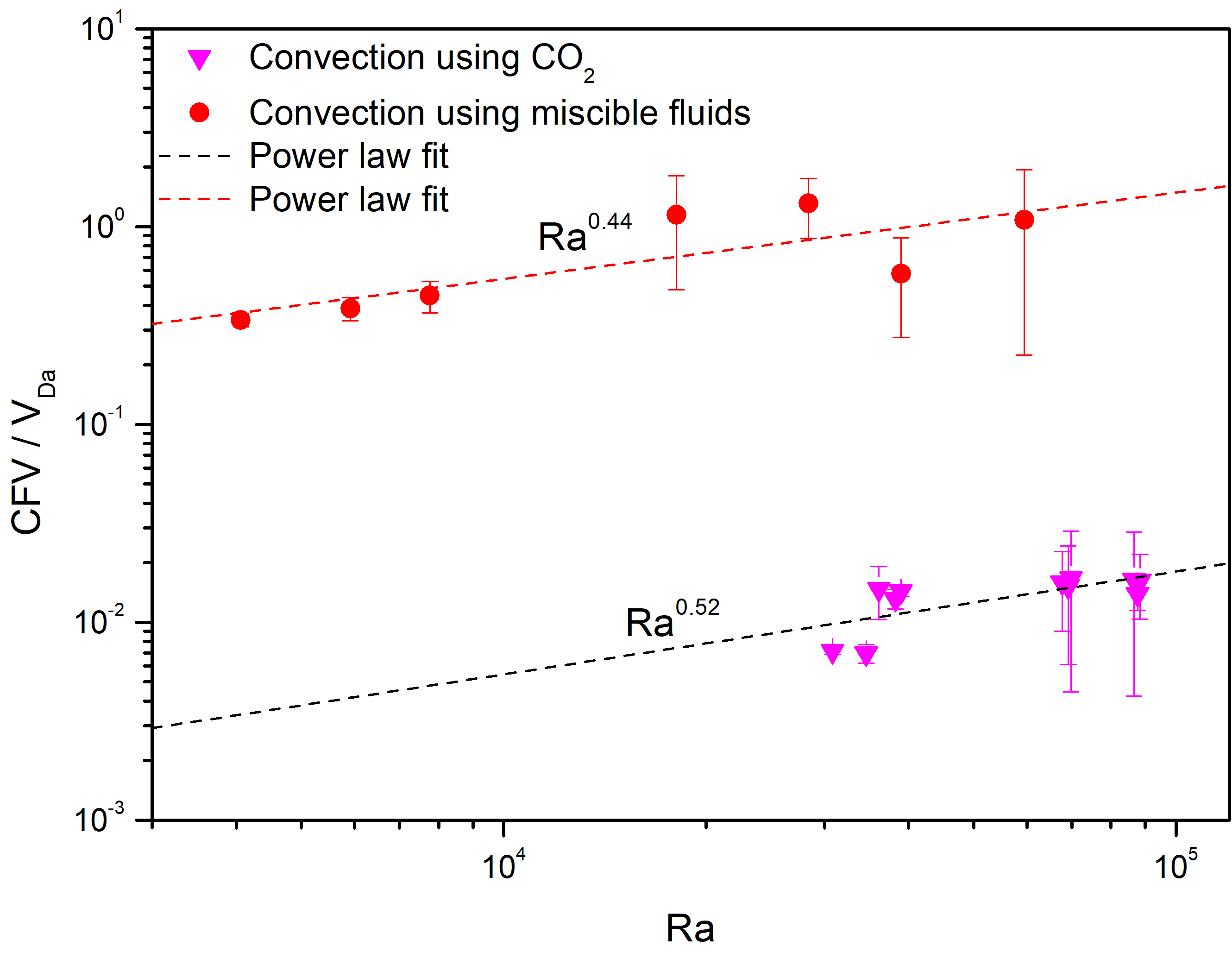
    • And the quantitative scaling of plume velocity with the Rayleigh number.

    Our results indicate that, within the studied conditions, the plume velocity approximately follows a square-root relationship with the Rayleigh number, providing new experimental support for predictions long established in theory and simulation. These measurements offer a valuable benchmark for refining models of CO₂ dissolution and improving forecasts of long-term storage efficiency.

    This work was made possible through collaboration with Fabrizio Croccolo, Paul Fruton, and Cedric Giraudet, whose contributions were essential to the project’s success.

    The article is available open access here:
    https://link.springer.com/article/10.1007/s11242-025-02259-0
  • Thermophysical Properties of CO2 Mixtures

    Thermophysical Properties of CO2 Mixtures

    By Happiness Inuetinyan

    Introduction

    Understanding the thermophysical properties of multicomponent fluid mixtures is crucial for industrial applications such as carbon capture and storage (CCS), enhanced oil recovery (EOR), and supercritical CO₂ processing. In our recent study, published in the Journal of Chemical & Engineering Data, we investigated the equilibrium thermophysical properties of ternary mixtures containing carbon dioxide (CO₂), cyclohexanol, and toluene. This research fills a critical gap in the literature, as previous studies have primarily focused on binary CO₂ systems, leaving ternary systems largely unexplored.

    Key Findings

    Phase Behavior

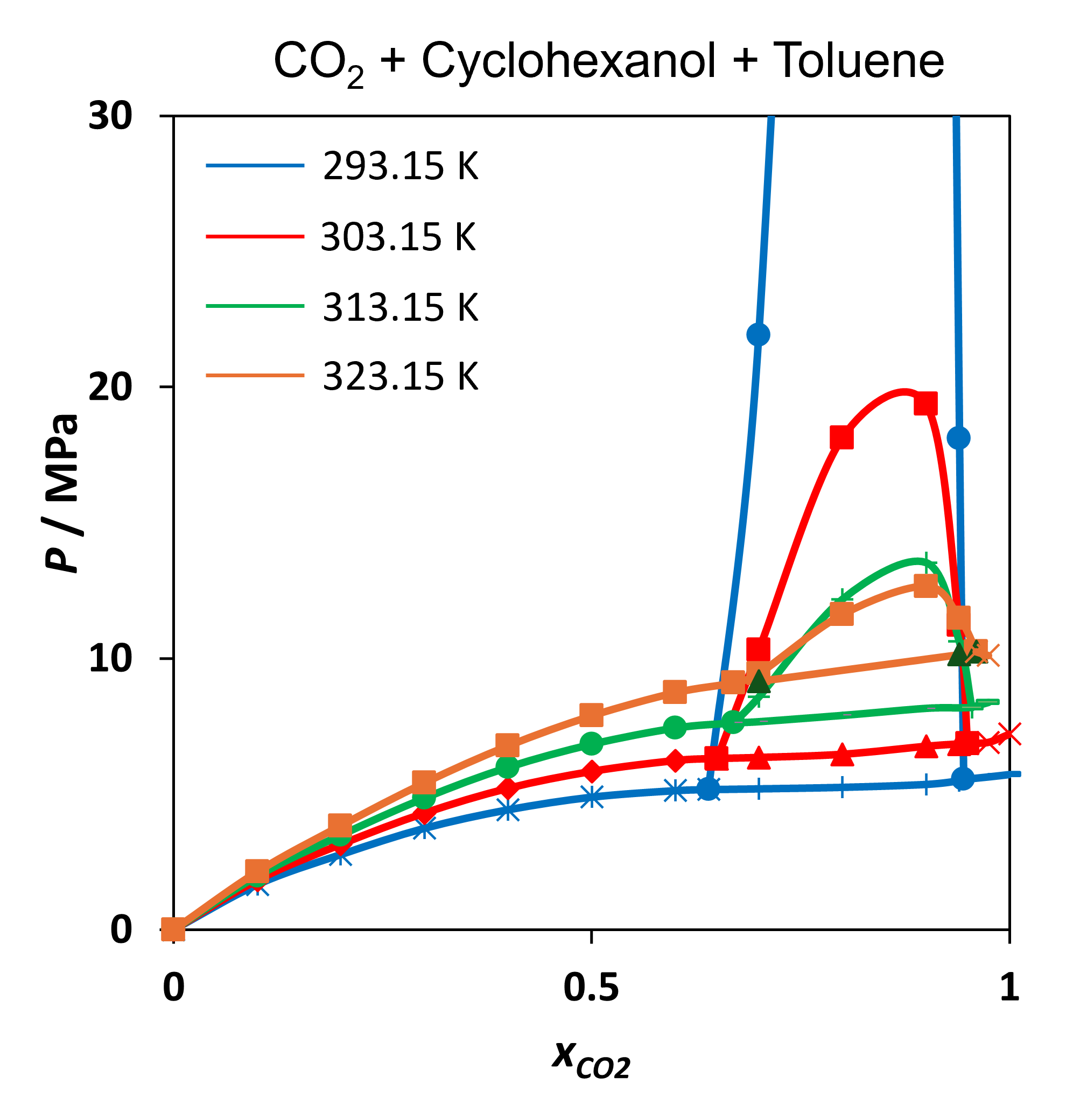
    Using a high-pressure variable-volume cell, we examined the phase behaviour of CO₂ + cyclohexanol + toluene mixtures across a temperature range of 293.15–353.15 K and pressures up to 30 MPa. Key observations include:

    • Liquid-Liquid Immiscibility: At CO₂ mole fractions exceeding 0.6 mol/mol, the mixture exhibited liquid-liquid immiscibility, particularly at lower temperatures (293.15–313.15 K).
    • Type III Phase Behaviour: The system displayed complex phase transitions, including liquid-liquid-vapour (LLV) equilibria, characteristic of Type III behaviour in the Scott and Van Konynenburg classification.
    • Pressure-Temperature Trends: Higher CO₂ concentrations increased the pressure required for phase transitions, resulting in a distinctive “U-shaped” curve in the pressure-temperature diagrams for CO₂-rich mixtures.

    Density Measurements

    Density data were collected for both binary (cyclohexanol + toluene) and ternary (CO₂ + cyclohexanol + toluene) mixtures using a vibrating U-tube densimeter. Notable results include:

    • Temperature Dependence: At lower temperatures (293.15–303.15 K), density increased with rising CO₂ content. However, at higher temperatures (333.15–353.15 K), density peaked at intermediate CO₂ mole fractions before declining.
    • Simulation Agreement: Molecular simulations predicted density trends with an average deviation of 1.7% from experimental data, validating the reliability of the computational models.

    Henry’s Law Constant

    Molecular dynamics simulations estimated the Henry’s law constant for CO₂ in the binary cyclohexanol + toluene mixture. The results showed:

    • Temperature Sensitivity: The Henry’s law constant increased with temperature, peaking at 533.15 K before decreasing.
    • Comparative Insights: While experimental data for the ternary system were scarce, simulations aligned well with existing literature for CO₂ solubility in pure toluene and cyclohexanol.

    Conclusion

    This study bridges a significant gap in the literature by offering comprehensive experimental and simulation data for the CO₂ + cyclohexanol + toluene system. The results highlight the complex interplay of temperature, pressure, and composition in determining phase behaviour and density, paving the way for further research into transport properties and broader industrial applications.

    For more details, check out the full paper here.


  • For Immediate Release

    For Immediate Release

    New Breakthrough in Transparent Porous Media For Optical Fluid Flow Measurements

    Anglet, France – October 30, 2024 — Researchers at the Université de Pau et des Pays de l’Adour have unveiled a new method to create transparent porous media for optical fluid flow measurement using refractive index matching (RIM), revolutionising how to visualise and analyse fluid movement through porous media using visible light.

    In a paper published in Applied Optics, lead author Happiness Imuetinyan, along with collaborators Paul FrutonCédric Giraudet, and Fabrizio Croccolo, presents a simple and reliable technique that uses shadowgraphy to achieve perfect index matching between porous solids and saturating fluids. This breakthrough significantly improves the transparency of porous media, enabling highly detailed, non-intrusive optical measurements that were previously hindered by distortions and light scattering.

    The team designed three transparent porous media using borosilicate glass beads and fluid mixtures tailored to match the refractive index at specific wavelengths. Their innovative method, based on optimising light intensity ratios and standard deviations, provides a quantitative, cost-effective solution applicable to a wide range of fields, including geological CO₂ storage, energy systems, and biological flow studies.

    “Our approach simplifies the process of making porous media optically transparent, opening new possibilities for high-precision flow experiments,” said Happiness Imuetinyan. “This technique offers researchers a powerful, accessible tool to deepen our understanding of complex fluid dynamics.”

    The research was conducted under the E2S UPPA Hub Newpores and Industrial Chair CO₂ES, with support from the Agence Nationale de la Recherche and the Petroleum Technology Development Fund in Nigeria.

    The full study is available at https://doi.org/10.1364/AO.536805.

    Contact:
    Happiness Imuetinyan
    Université de Pau et des Pays de l’Adour
    Email: happiness.imuetinyan@univ-pau.fr

  • Convective Plumes in Porous Media

    Convective Plumes in Porous Media

    I am excited to share some insights into our recent research focused on visualising fluid flow within porous media. This work is important for understanding a range of natural and industrial processes, from groundwater pollution to underground CO2 storage.

    The Challenge: Seeing the Unseen

    One of the biggest hurdles in studying flow in porous media using visible light is that it is usually impossible to see what is happening within the medium. Traditional optical techniques just don’t work because the medium itself is opaque.

    Our Solution: Making the Invisible Visible

    To tackle this, we developed a novel experimental approach using shadowgraphy. The key was to create a transparent porous medium by carefully matching the refractive index of the solid and liquid phases. This allowed us to directly observe convective plumes as they spread.

    What We Discovered

    Our experiments revealed a clear relationship between the density difference of the fluids and the velocity of the convective plumes. This is a significant finding because it provides a way to predict the intensity of convective mixing by measuring the speed at which the plumes move.

    Why This Matters

    This research has the potential to advance our understanding in several areas, including:

    • Environmental science: Improving strategies for groundwater remediation.
    • Energy industry: Optimising techniques for underground storage of CO2.

    What’s Next?

    Our future work will delve deeper into the convective mixing of CO2 in porous media under process-relevant pressure and temperature conditions.

    Want to Learn More?

    For those interested in the technical details, the full paper is available here.